Updates / Essays /
Why We Built EOS Orbit
In 2024 our first satellite reached orbit, and the carrier door that was meant to release it never opened. We started the second one the next morning.
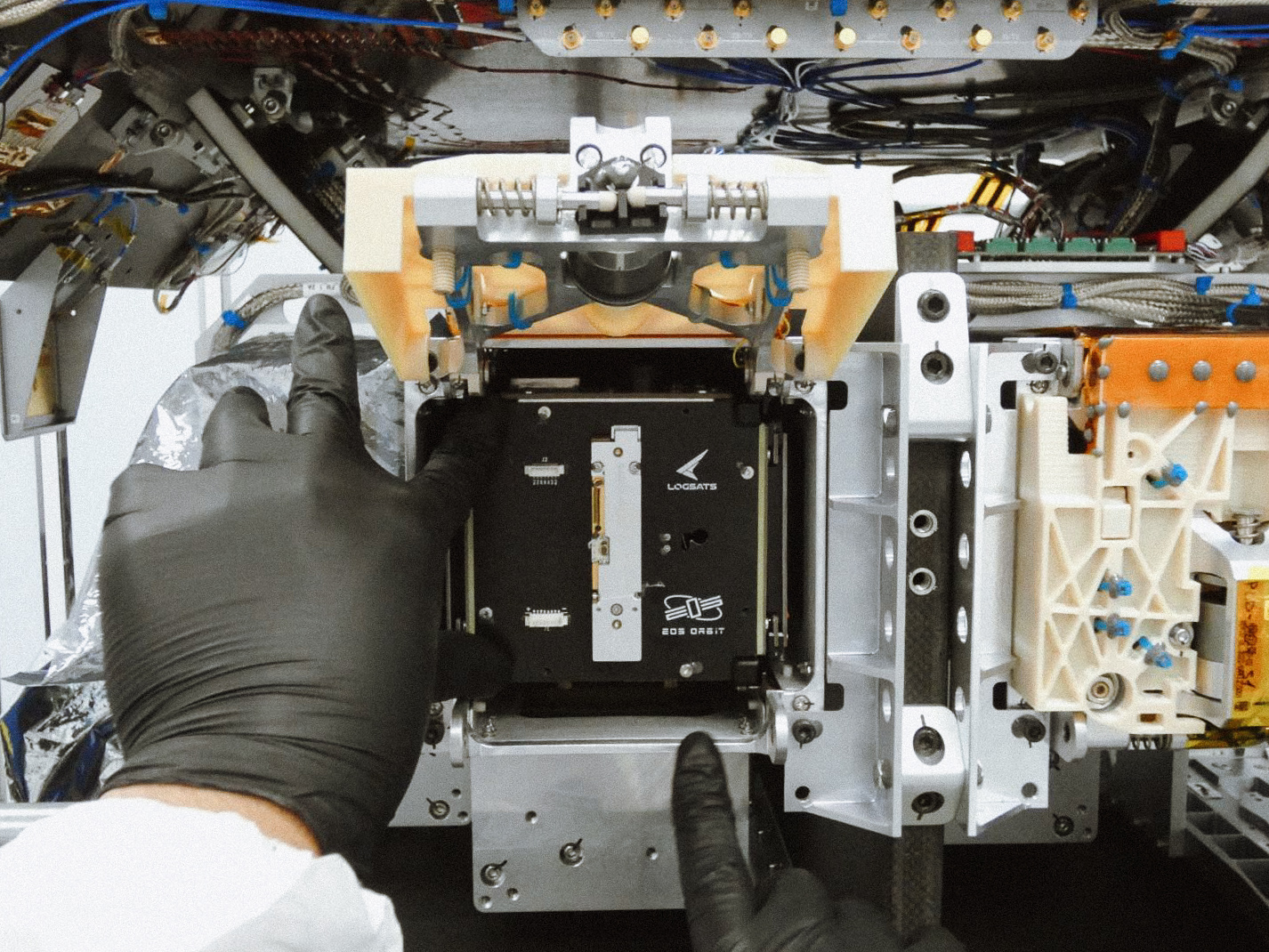
In 2024, our first satellite reached orbit on a SpaceX launch. LOGSATS-1. The team had designed it, built it, tested it, carried it by hand to the launch site. It made the ride. But the carrier door that was meant to release it into orbit never opened. Two payload doors out of ten failed on that flight. Ours was one of them.
The satellite was sound. Telemetry confirmed the systems were ready. None of that mattered. Without deployment, the work did not count.
We had a decision to make the next morning. We could pause, investigate, run more simulations. That would have been the cautious path. It would also have been the path that might take months or years and might never yield a clear answer.
Or we could trust what we knew about our own engineering and build again.
We started LOGSATS-2 the next morning. Twelve months later it reached orbit. It operated through its full mission, did the work it was designed to do, and closed the loop on a question that had been open since the carrier door failed. The systems worked. The team could execute under conditions that would break most organizations. Whatever happened to the first satellite did not originate in our approach.
The decision to push forward was not obviously correct at the time. Capital was limited. A second failure would have ended the company. The conservative choice was to pause, derisk, wait for better information. We did something else. We bet the company on crossing the threshold fast, because credibility in aerospace works by thresholds and not by gradients. Either there is hardware in orbit, or there is not. A company on one side of that line lives in a different category from a company on the other side, and no amount of preparation closes the gap from the wrong side.
Why no one had gone first
What this required us to confront, from inside the work, was a set of assumptions about the region that did not survive contact with reality. The standard story is that space capability in Southeast Asia is too advanced for local execution, too expensive for local capital, and too specialized for local talent. So countries in the region must purchase satellites from abroad, contract launches from foreign providers, and license data from operators incorporated elsewhere.
The story is wrong on every count.
The technology is not too advanced. Satellite systems use components that are often less sophisticated than what powers a modern smartphone. Radiation-hardened processors lag generations behind consumer electronics. The physics of orbit is well understood. The engineering is demanding without being exotic.
The costs are not prohibitive. Small satellites can be built and launched for a fraction of what legacy programs spend. The economics shifted in the past decade and have not shifted back.
The talent exists. Thai engineers work at leading aerospace companies around the world. They complete graduate programs at top universities. They build sophisticated systems in adjacent industries. The talent is real and it is here.
So the region’s dependence is not a technical fact. It is a coordination problem. Investors will not commit capital to an unproven category. Engineers will not build careers in an industry that does not visibly exist. Government procurement officers will not select a domestic supplier who has never delivered a working system. Everyone waits for someone else to go first.
The condition that holds the region back is not a missing capability. It is a missing precedent. Capability follows precedent. Precedent has to be paid for by someone willing to absorb the cost of being first.
What proof unlocked, faster than expected
What changed when LOGSATS-2 reached orbit was that proof started accumulating, and the rate at which the coordination problem dissolved turned out to be faster than anyone expected.
Five months ago, the company was founder-backed. No institutional capital. No public-markets surface area. We knew our hardware worked. We did not know how quickly that fact would translate into anything else.
In February 2026, SET-listed JTS committed up to 500 million baht to EOS Orbit for a 19.23 percent stake. The SET filing is public record. The commitment came because the proof was already there. What had been an unprovable thesis weeks earlier was, by February, a priced one.
The reason the region waits is not that no one wants the work done. It is that no one wants to commit absent evidence. When evidence arrives, the waiting ends. The pace of that ending is faster than most observers, including us, expected.
What does not transfer
Suppose a well-funded competitor appeared tomorrow and tried to do exactly what EOS Orbit does. Where would they struggle?
They would not struggle for technology. Our satellite designs are not secret. The components are commercially available. A motivated team could study our approach and approximate it.
They would not struggle for capital. Capital follows proof, and proof is a public artifact once it exists.
What they would lack is the texture of experience.
Which component vendors deliver what they promise and which do not. How thermal cycling affects specific solder joints over months in orbit. The operational procedures we developed after anomalies that never became published papers. The intuition the team built by working through launch campaigns together, under deadlines that seemed impossible, and coming out the other side intact and still talking to each other.
This kind of knowledge does not transfer easily. It cannot be acquired through a hiring cycle and cannot be reverse-engineered from public materials or conference presentations. It lives in the people who did the work and learned from it together, over years.
EOS Orbit started early, in an environment where no one else in the region was doing this work. We paid the cost of learning when that cost was ours alone to bear. Every month that passes, the gap compounds. A new entrant would have to pay the same tuition we paid. By the time they graduated, we would be years further along.
What we protect
Two commitments have stayed constant, even when they made everything harder.
The first is building our own core technology. When we could have purchased a complete satellite bus from a foreign supplier, faster and lower risk, we designed and built it ourselves. When we could have licensed flight software with documentation and support contracts, we wrote our own.
Dependency creates vulnerability. A company that depends on foreign suppliers for its essential systems is not really a space company. It is a systems integrator with exposure to decisions made in other countries, by other people, for other reasons. When those suppliers restrict access, raise prices, or simply decide your market is no longer a priority, the dependency becomes visible. We have watched this happen to others. We chose a different path.
The second commitment is to standards held without bureaucracy. EOS Orbit is a small team. We cannot afford layers of process documentation, formal review boards, the mechanisms that large aerospace organizations use to ensure quality. What we have is simpler and harder. Every person on the team works as if they are personally signing their name to the final product. The team’s standard is whether each engineer would stand behind their part of the work in five years.
This requires hiring people we trust completely and then actually trusting them. It also means we are slow to engage with anyone, partner or customer, who treats space as a status symbol rather than a technical discipline. The difference is recognizable early.
What proof unlocks
Putting a satellite in orbit demonstrates that the work can be done from here, by people who live here, in a company incorporated here. Hiring a young engineer from a Thai university makes that career path real and not theoretical.
The effects ripple. Students who see a Thai company operating satellites can aim at aerospace as a real destination. Investors who see delivered work make capital available for adjacent companies. Government agencies that see domestic capability shift the logic of procurement. An ecosystem that did not exist starts to become possible, not because anyone willed it into being, but because proof made participation rational.
What the work removed was doubt. Once doubt is gone, action no longer requires belief. The necessary condition for hesitation is no longer present.
What’s next
LOGSATS-2’s mission is complete. Equarion, the next satellite, is in build. It is the company’s first Earth observation satellite. Build is not flight. The question that mattered in 2024, whether the team could put hardware in orbit and operate it, is no longer the question. The questions in front of us now are about extension. More satellites, deeper capability, sustained operations over years.
The discipline that made the first satellite possible is the same discipline required to make the tenth one possible. The work does not get easier with category installation. It gets more visible, which is a different problem.
EOS Orbit keeps building.
EOS Orbit is Thailand’s sovereign space infrastructure company. We design, build, launch, and operate satellites end-to-end.